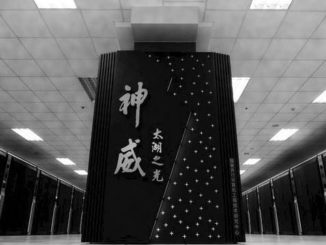
A First Peek At China’s Sunway Exascale Supercomputer
The trade war between the United States and China is not just a top-down political and economic one, but also a technical one. …
At the ISC conference this week, HPC market analyst firm Hyperion Research offered its mid-year HPC market update, which recapped what happened in 2018 and provided some particularly interesting observations on the exascale space. …
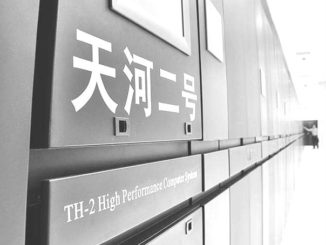
One reason China has a good chance of hitting its ambitious goal to reach exascale computing in 2020 is that the government is funding three separate architectural paths to attain that milestone. …
A major part of China’s several initiatives to build an exascale-class supercomputers has been the country’s determination to rely mostly on homegrown technologies – from processors and accelerators to interconnects and software – rather than turn to vendors outside of its borders, particularly those from the United States. …
Gone are the days of early warehouse scale computing pioneers that were based in the U.S.. …
The field of competitors looking to bring exascale-capable computers to the market is a somewhat crowded one, but the United States and China continue to be the ones that most eyes are on. …
As an economic powerhouse and with a rising military and political presence around the world, you would expect, given the inherent political nature of supercomputing, that China would have multiple and massive supercomputing centers as well as a desire to spread its risk and demonstrate its technical breadth by investing in many different kinds of capability class supercomputers. …
Chinese officials have made no secret out of their desire to become the world’s dominant player in the technology industry. …
The 13th Five Year Plan and other programs to bolster cloud adoption among Chinese businesses like the Internet Plus effort have lit a fire under China’s tech and industrial sectors to modernize IT operations. …
China represents a huge opportunity for chip designer ARM as it looks to extend its low-power system-on-a-chip (SoC) architecture beyond the mobile and embedded devices spaces and into new areas, such as the datacenter and emerging markets like autonomous vehicles, drones and the Internet of Things. …
All Content Copyright The Next Platform