Nvidia Tapped To Accelerate RIKEN’s FugakuNext Supercomputer
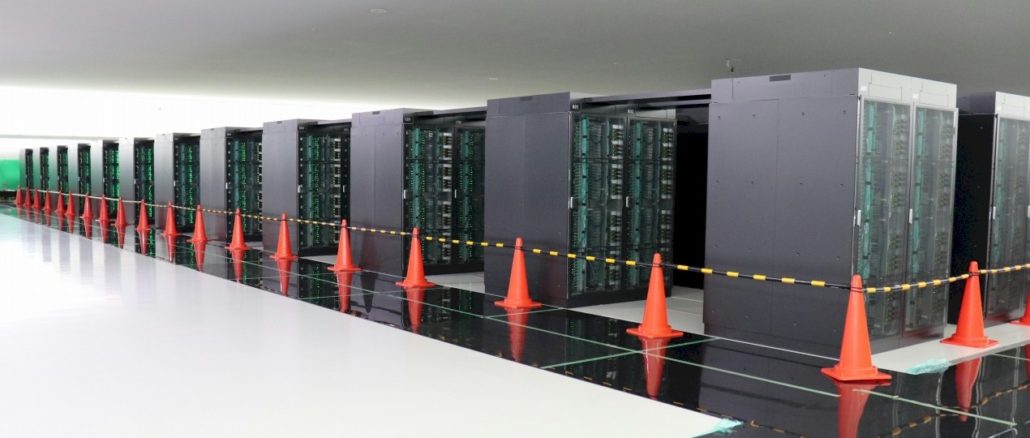
It has been clear for some time that Japan wants to have a certain amount of economic and technical independence when it comes to cloud computing in the Land of the Rising Sun. …
Very few organizations have enough iron to train a large language model in a reasonably short amount of time, and that is why most will be grabbing pre-trained models and then retraining the parameters in the models with much smaller datasets that are important to them. …
Let the era of 3D V-Cache in HPC begin.
Inspired by the idea of AMD’s “Milan-X” Epyc 7003 processors with their 3D V-Cache stacked L3 cache memory and then propelled by actual benchmark tests pitting regular Milan CPUs against Milan-X processors using real-world and synthetic HPC applications, researchers at RIKEN Lab in Japan, where the “Fugaku” supercomputer based on Fujitsu’s impressive A64FX vectorized Arm server chip, have fired up a simulation of a hypothetical A64FX follow-on that could, in theory, be built in 2028 and provide nearly an order of magnitude more performance than the current A64FX. …
Supercomputers are designed for a number of big jobs that can only be done by massively powerful machinery, and one of those jobs has been the modeling of chemical compounds and biological systems, often in concert to model diseases and to help find cures for them. …
Nvidia has spent much of the year launching new products and partnerships that aim to ensure it keeps its place atop the wild west that is still the AI market while establishing its place in the emerging quantum computing space, where co-founder and chief executive officer Jensen Huang sees Nvidia being a key infrastructure provider and accelerator. …
It has taken nearly two decades and an immense amount of work by millions of people for high performance computing to go mainstream with GenAI. …
As we talked about a decade ago in the wake of launching The Next Platform, quantum computers – at least the fault tolerant ones being built by IBM, Google, Rigetti, and a few others – need a massive amount of traditional Von Neumann compute to help maintain their state, assist with qubit error correction, and assist with their computations. …
The European Union cannot practically declare its independence from Nvidia GPUs any more than any other nation can at this point. …
The AI era has a much different vibe than prior eras in the IT industry. …
If you want to buy an exascale-class supercomputer, or a portion of one so you can scale up, there are not a lot of places to go shopping because there are not a lot of companies who have a balance sheet that is big enough to get all of the parts to build the machines. …
All Content Copyright The Next Platform